
Love’s Ashes at the Wedding of the One Who Burned Him
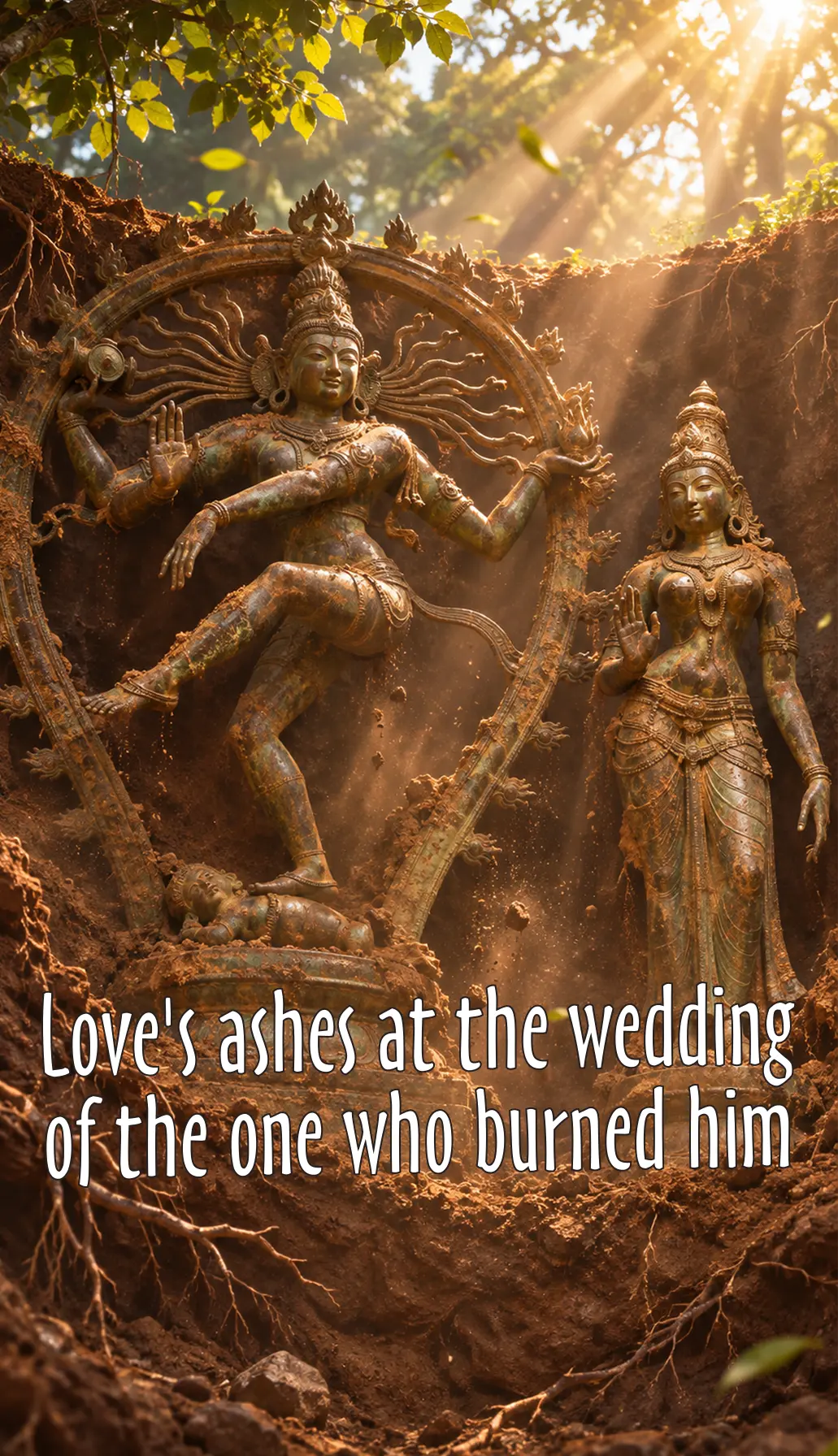
On October 30, 2026, news of a remarkable archaeological discovery emerged from India. About a metre beneath the ground, two bronze statues dating back roughly nine hundred years had been uncovered.
One depicted Shiva in his Nataraja form, dancing with four arms, holding a drum in one hand and fire in another. The other represented his wife Sivakami, also known as Parvati.
These two figures, buried for nearly nine centuries, recalled a far older story in which love had been tested by fire. One held flames in his hand; the other carried a history of devotion that had struggled to find its answer. Yet the path towards their union was intertwined with the separation of another pair of lovers.
Shiva’s Fire and Kama’s Ashes
In ancient Indian mythology, Shiva had withdrawn from the world into deep meditation. Parvati loved him, but her feelings went unanswered, and the distance between them seemed impossible to overcome.
Those who wished to bring them together sought the help of Kama, the embodiment of desire. Kama possessed the power to awaken attraction in people’s hearts and set love in motion. He was, in a sense, Love made flesh. Taking his flower-tipped arrows, he set out towards the silence of Shiva’s retreat, accompanied by all the vitality of spring.
Yet Love himself was also in love. He had a wife named Rati. The one who could awaken affection between others had no idea that he was about to lose his own beloved.
When he aimed his arrow at the figure absorbed in meditation, the outcome was not what he had hoped. Shiva, angered by the disturbance, opened his third eye, and the fire that burst forth reduced Love to ashes.
The one who had tried to awaken love in another heart was separated from the one he loved.
The woman who loved Love was left behind.
Her loss was more than the absence of someone dear to her. The undertaking that had brought her husband to his death had been carried out at the request of others. An attempt to awaken love in one heart had cost another person her beloved.
The story of the woman who loved the one who had burned Love, however, took a different path.
Although her feelings were not returned, she did not abandon them. She devoted herself to a demanding life of spiritual discipline and retreat. The closeness that flower-tipped arrows had failed to create gradually found another path through patience and perseverance. The one who had burned Love eventually returned the affection offered to him, and the two were married.
And so, the one who had burned Love finally came to know the very feeling he had once kept at a distance.
Love’s Ashes at Shiva’s Wedding
Yet while everyone celebrated the wedding, the suffering that had preceded this union remained unresolved.
The woman who loved Love arrived at the ceremony carrying her husband’s ashes and stood before Shiva. The one who had reduced her beloved to ashes was now marrying the woman who loved him, while she herself remained alone. Holding out the ashes, she asked for her husband to be returned to her.
In the wedding account of the Shiva Purana, other women join her plea. The one who had burned Love listens to their words and, with a compassionate gaze, restores to life the one he had reduced to ashes.
The woman who loved Love finds herself once more face to face with her beloved.
When the one who had burned Love came to know love, he was also confronted with the love his destruction had left behind.
What he had once destroyed in anger, he now restored through compassion. Yet this change was not brought about solely by the affection he had received. There was another love at work: the devotion of someone who, after losing her beloved, refused to remain silent and would not give up asking for his return.
The love of these two women had followed different paths. One had remained steadfast despite her feelings going unanswered; the other had preserved her devotion even after losing the person she loved. The love of the first found an answer in the heart that had rejected it, while the love of the second awakened compassion in that very same heart.
The Love That Fire Could Not Destroy
In the world we know, however, loss does not always end this way. Cities destroyed by war may be rebuilt, but some people never return. New houses can rise where others have burned, yet the moments once lived within those walls cannot all be recovered. More often than not, embracing a lost loved one again is simply impossible.
Still, the existence of love cannot be measured by reunion alone. The affection we hold for someone whose name we continue to speak in their absence, whose memory we preserve, and whose presence remains with us long after they are gone continues to live in different forms within those left behind.
During the days when Venus was retrograde in Libra, the reappearance of two bronze figures nearly nine hundred years old created a striking symbolic connection with this ancient story.
One of the figures brought back into daylight held fire in his hand. The other stood beside the one who had once rejected love. Yet another part of the story was missing: the woman who had carried her beloved’s ashes to confront the happiness of the newly married couple.
Fire had destroyed Love’s body. But it had failed to extinguish the love of the woman who loved him, or to prevent the love of the woman who loved the one who burned him. In the end, it was love itself that awakened compassion in the one who had burned Love.

