
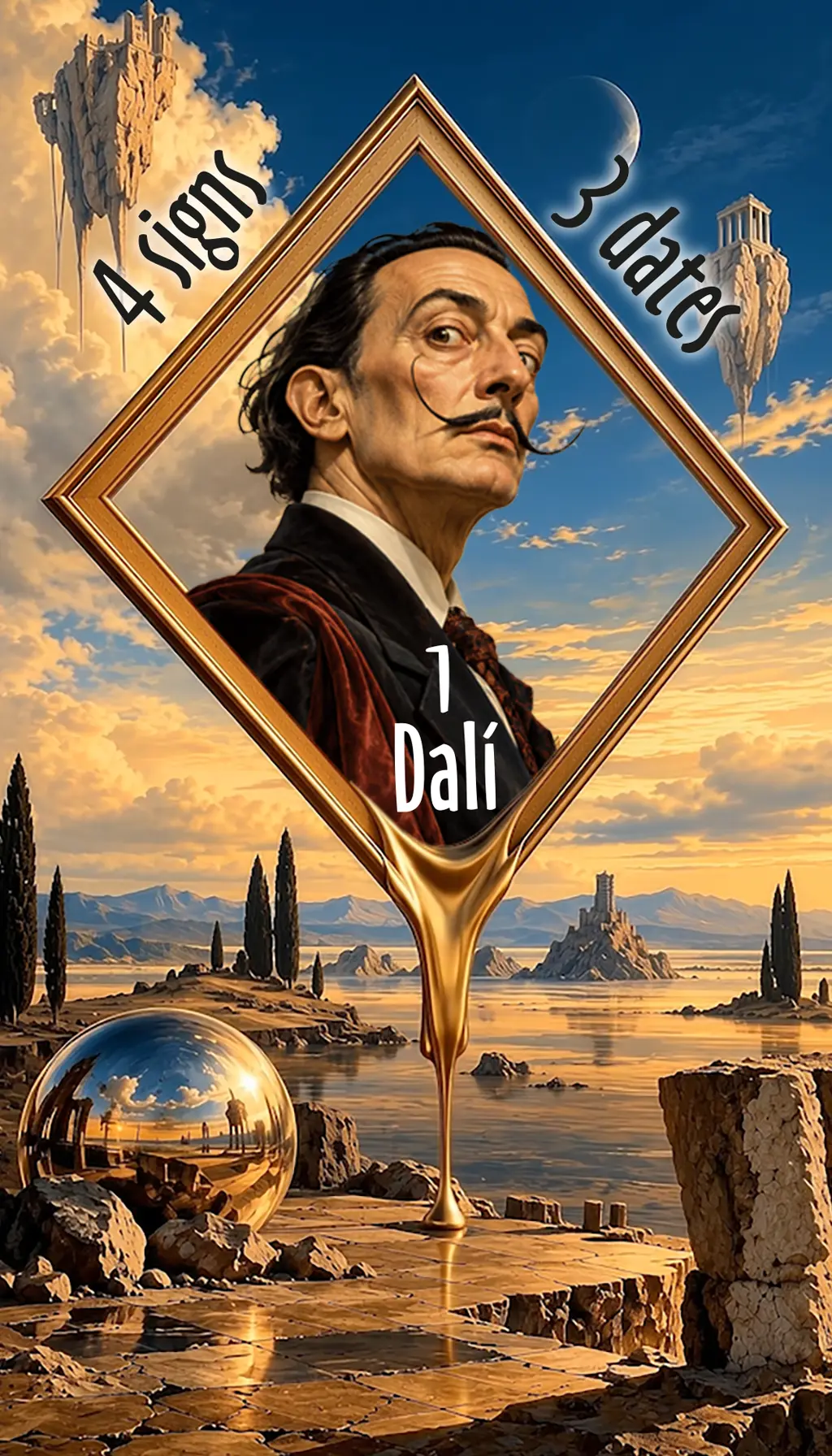
4 Signs, 3 Dates, 1 Dalí
On 20 October 2026, The Freudian Universe of Dalí, an exhibition at Madrid’s Museo Nacional Thyssen-Bornemisza, brought an enormous theatrical curtain back before the public more than eighty years after its creation.
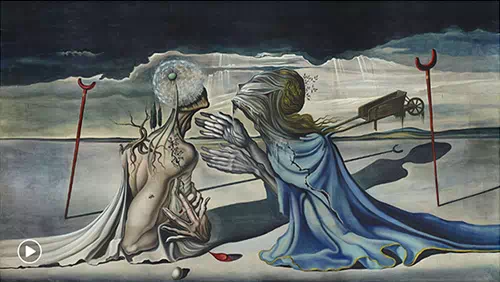
Almost nine metres high and fifteen metres wide, the curtain had been made by Salvador Dalí for Tristan Fou, a ballet that reached the stage in 1944 under the title Mad Tristan.
At the time of the exhibition’s opening, Venus was retrograde in Scorpio. There was something striking about the return of a story in which love, desire and death were so closely intertwined. Yet looking back through the history of the work revealed other astrological correspondences linking moments separated by decades.
To follow them, imagine a square frame turned so that one corner points upwards. Place Taurus at the top, Aquarius on the right, Scorpio at the bottom and Leo on the left.
Three moments in Dalí’s life will gradually find their place within these four corners.
An artist who drew his own boundaries
Salvador Dalí was born on 11 May 1904 in Figueres, Catalonia. In his birth chart, the Sun is in Taurus, at the upper corner of our frame, while Saturn is in Aquarius, on the right. They form an almost exact square.
Mercury and Mars are also close to the Sun, while Saturn occupies a sign it rules, giving it a particularly strong position.
This arrangement suggests a determination to turn ideas into tangible works, a reluctance to accept limits imposed by others, and yet an ability to maintain strict discipline in his own creative practice.
A similar tension can be seen in Dalí’s life. While studying at the San Fernando Academy of Fine Arts in Madrid, he challenged the examination board’s ability to judge him and was expelled in 1926. At the same time, he studied the techniques of the old masters with extraordinary care, bringing his surrealist visions to the canvas with meticulous precision.
He questioned the rules imposed upon him while setting demanding standards for his own art.
Another powerful influence on his creative thinking was Sigmund Freud, the founder of psychoanalysis.
1938 — The unseen side of love
As a young man, Dalí had read Freud’s The Interpretation of Dreams, developing a deep fascination with the unconscious and the world of dreams. Through his paranoiac-critical method, he began creating images that could be perceived in more than one way.
In 1938, he wanted to bring this approach to the stage.
He chose the medieval tragedy of Tristan and Isolde, later transformed into an opera by Richard Wagner. Its lovers are caught between their feelings and the duties they are expected to fulfil. Their longing to be together leads towards separation and death.
Dalí, however, was not content with the story’s romantic surface.
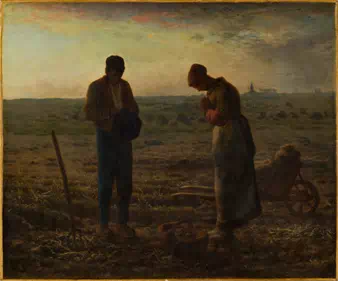
In April 1938, while in Monte Carlo, he prepared a text for Tristan Fou that drew on psychoanalysis, the praying mantis and Jean-François Millet’s painting The Angelus. Wagner’s tragic love story became a way of exploring desire, fear and the less visible workings of the mind.
During those days, Venus was moving through Taurus in the sky, approaching the Sun in Dalí’s birth chart at the upper corner of our frame. At the same time, it formed a square with Saturn on the right.
Venus, symbolically associated with love and desire, was now entering the tension between creative will and limitation. The same themes were unfolding in the story Dalí was preparing for the stage.
Yet the artist had still not met Freud in person.
Their long-awaited meeting took place in London on 19 July 1938.
The Austrian writer Stefan Zweig arranged the visit. Dalí was accompanied by Edward James, an art collector and patron of his work.
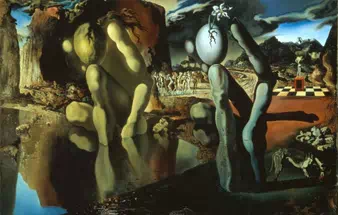
They brought The Metamorphosis of Narcissus, a 1937 painting in which two different images coexist within a single composition. Dalí hoped to use it to explain his paranoiac-critical method to Freud.
The following day, Freud wrote to Zweig that Dalí’s technical mastery had made him reconsider his earlier opinion of the Surrealists. This did not mean he accepted all of the artist’s ideas. Nevertheless, Dalí had finally met the thinker whose writings he had admired for years.
On that 19 July, Mercury was in Leo, at the left corner of our frame. It formed an almost exact square with the Sun in Dalí’s birth chart and an opposition to Saturn.
It was striking that Mercury should so precisely emphasise this relationship on the very day Dalí was trying to communicate his ideas and explain his method to Freud.
1944 — Tristan takes the stage
The project conceived in 1938 premiered on 15 December 1944 in New York, under the title Mad Tristan.
With choreography by Léonide Massine, the production featured Dalí’s enormous painted curtain, bringing his surrealist imagery into the world of Tristan and Isolde.
Freud had died in 1939 and could not see the performance. His ideas, however, continued to shape Dalí’s visual imagination.
On the day of the premiere, Venus was in Aquarius, forming a very close square with Venus in Dalí’s birth chart, in Taurus.
In 1938, while the project was taking shape, Venus had approached his Sun. Six years later, as the work reached the stage, it was forming a connection with the Venus in his birth chart instead.
An idea imagined years earlier had finally taken visible form on stage.
2026 — The four corners come together
More than eighty years later, the exhibition in Madrid once again drew attention to Dalí’s relationship with Freud and the lasting traces of that intellectual encounter in his art.
On 20 October 2026, Mercury was moving through Scorpio. Placing it at the bottom of our frame completes the four corners.
At the top are Dalí’s birth-chart Sun and the Venus of 1938 in Taurus. On the right is his Saturn in Aquarius. On the left is Mercury in Leo from the day he met Freud. And at the bottom is Mercury in Scorpio at the opening of the exhibition.
What makes the pattern remarkable is that all these positions fall around the 20th degree of their respective signs. The Venus of April 1938 and the Mercury of October 2026 also occupied closely corresponding degrees in two opposite signs.
These positions did not occur together in a single sky. They belong to different moments: Dalí’s birth, the creation of Tristan Fou, his meeting with Freud and the exhibition that brought the work back into view.
Venus offers another thread connecting these years. At the 1944 premiere, it formed a square with Venus in Dalí’s birth chart. In 2026, while retrograde in Scorpio, it stood opposite that same birth-chart position.
These astrological correspondences cannot be regarded as causes of historical events. They do, however, offer another way of looking at the journey of a work of art.
As Venus moved retrograde through Scorpio, an old story about love, desire, loss and death returned to public view.
The descent of Inanna into the underworld evokes related themes. In one story, something must be left behind. In the other, love searches for meaning in the face of separation and death.
Dalí’s work does not offer definitive answers to these questions. Instead, it allows their different faces to become visible.
The curtain, seen again after more than eighty years, does not change the story it tells. It simply allows us to see that story from another moment in time.
Perhaps this is part of what allows certain works to endure: they remain unchanged, yet reveal something different each time we encounter them.

