
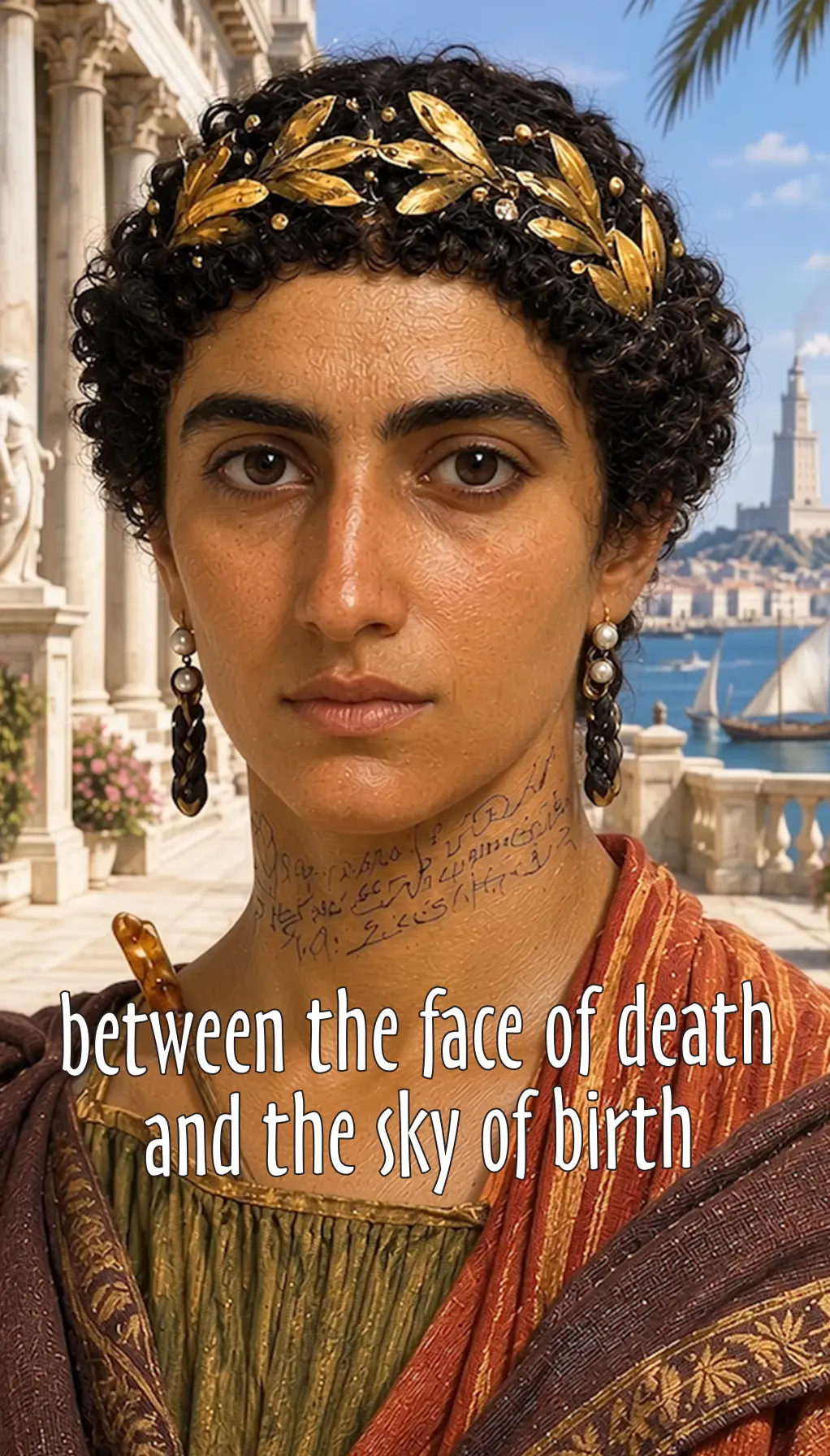
Between the Face of Death and the Sky of Birth
On November 5, 2026, Rome’s Ara Pacis Museum opened its doors to faces from nearly two thousand years ago. The exhibition The Power of the Portrait: Egypt and Rome, Faces of the Fayum brought together portraits of people whose lives remain largely unknown. Their faces had survived, while their names, joys, fears, and much of the stories they left behind had faded into history.
One of these women is known as Eirene.
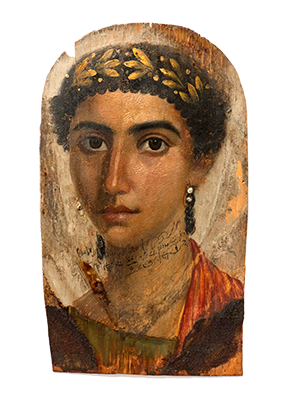
Mummy portrait of Eirene — Landesmuseum Württemberg, Stuttgart.
AD 40–50 — A Face
A young woman looks directly ahead. A wreath of golden leaves rests on her dark hair, and she wears a green tunic with a reddish mantle. Yet what makes her portrait remarkable is not simply that it has survived. Across the neck is an inscription in Demotic, one of the scripts used to write the Egyptian language at the time.
The inscription identifies her father as Silvanos and her mother as Senpnoutis. It continues with a prayer addressed to Osiris-Sokar, a combined sacred identity bringing together Osiris, lord of the afterlife, and Sokar, associated with the dead and their tombs. Before this divine figure, invoked as lord of Abydos, one of Egypt’s most important religious centres, a wish is expressed that Eirene’s soul may live forever.
This was no ordinary portrait kept as a personal remembrance. Painted on a wooden panel, the image had been placed among the mummy’s wrappings, directly over the deceased woman’s face. Traces of linen and mummification materials show that the portrait had once been attached to her body. In this way, her face became part of the journey into existence beyond death.
The exact place where Eirene’s portrait was discovered is unknown.
Its tradition, however, is most closely associated with the Fayum region, southwest of Cairo. The many portraits recovered from cemeteries there eventually gave their name to similar works found in other settlements along the Nile.
We do not know where Eirene was born, how she lived, or when she died. Nor can we say with certainty whether her portrait was painted during her lifetime or after her death. But we do know what was wished for her. Her likeness was placed upon her mummy, her name was written alongside those of her parents, and a prayer was offered for the continued existence of her soul.
In 30 BCE, the end of the Ptolemaic dynasty brought Egypt’s Hellenistic kingdom to a close, and the country passed under Roman rule. Political change, however, did not erase its ancient beliefs. The desire to preserve the body and secure an existence after death reached far beyond the Hellenistic age, into Egyptian funerary traditions that had developed over thousands of years. While Greek and Roman influences appeared in everyday life, clothing, and portraiture, Egyptian mummification practices and beliefs about the afterlife continued.
Different cultures could thus leave their traces upon the same body.
Eirene’s portrait was more than the image of a woman who had once lived. It was also part of an identity intended to endure beyond death.
But during those same years, what happened when a new life entered the world?
AD 46 — A Sky
From the ancient city of Oxyrhynchos, south of the Fayum and now known as El-Bahnasa, a birth chart dated January 3 has survived.
Written on papyrus, the horoscope was preserved among the family papers of Tryphon, a weaver. Researchers consider it possible that the chart belonged to Apion, the son of Tryphon and Saraeus.
The document places the Sun in Capricorn, the Moon in Aries, and Jupiter in Cancer. Virgo is identified as the rising sign, with Gemini at the Midheaven. Although some planetary positions differ from modern calculations, the intention to record the celestial arrangement at the moment of birth is unmistakable.
The language of the text is equally striking. The Sun is described as the ruler of the universe, and the Moon as the mother of all things. The planets appear not merely as luminous bodies in the sky, but as elements of a larger order through which a person’s arrival in the world could be understood.
The care taken to preserve Eirene’s face after death finds a meaningful contrast here, in the wish to record the heavens at the beginning of a life. One record concerned an identity intended to survive; the other looked towards a lifetime still to unfold.
Yet the documents belonging to Apion’s family were not concerned with the heavens alone.
In AD 49, his mother, Saraeus, appears before a court to defend her young son’s freedom. Following the death of another child whom she had nursed for payment, that child’s owner claims Apion is actually his slave. Contracts and payment records are examined. The official observes that the boy resembles his mother and rules in Saraeus’s favour, provided that both parents take the required oath and the money received is repaid.
The same family archive that preserved a possible birth chart for Apion therefore also contained a court record in which the child’s resemblance to his mother had helped protect his identity.
In Fayum portraits, the face helped preserve identity beyond death. Here, the face of a living child played a part in establishing who he was.
Astrology and Rebirth in Egyptian Temples
Recording the sky at birth was not entirely separate from everyday life in Roman Egypt. In temples throughout the Fayum region, ancient Egyptian religious traditions continued alongside the study of astronomy and astrology. Some priests observed the heavens, calculated planetary positions, prepared birth charts, and interpreted them.
Fragments of pottery, papyri, and astrological manuals preserve evidence of these activities. People sought answers about their futures and could commission a birth chart even years after they had been born. Some calculations were recorded in writing, while much of the advice and interpretation has been lost.
The sky calculated for the moment of birth could become a source of knowledge consulted in the years that followed.
Other surviving evidence suggests that this relationship with the heavens could take on a different meaning after death.
Some coffins and tombs from Roman Egypt contain representations of the zodiac. According to the researcher Andreas Winkler, certain examples may have been intended to recreate the celestial arrangement at the deceased person’s birth, helping to bring about rebirth in the afterlife.
In this way, the heavens consulted to understand the beginning of life could also become part of the hope for a new beginning beyond death.
There is no evidence connecting Eirene’s portrait to such a zodiac. Nor do we know which astrologer prepared the possible birth chart of Apion. Nevertheless, these separate records reveal some of the questions surrounding human existence during the same period.
The Traces That Remain After Two Thousand Years
On one side were those seeking to understand the celestial order of a life yet to be lived; on the other, those hoping to preserve a person’s identity beyond death. Calculations made in temples, papyri kept by families, portraits placed upon mummies, and prayers offered for the dead approached a shared question from different directions: how can a human existence be given meaning, and how can something of it be preserved?
These were not pieces of a single personal record maintained for everyone from birth until death. Yet when viewed together today, they can be read as traces left at different thresholds of life.
We know Eirene’s face, but not the story of her life. We know the birth sky that may have belonged to Apion, but not what face he left behind when he died.
Even the name inscribed across Eirene’s neck cannot be read with complete certainty two thousand years later. Some scholars believe that the woman we call Eirene may have been named Helene.
Despite every effort to carry an existence into the future, both in life and after death, time has dimmed the traces of many of those ancient records.
But not all of them.
We still have the calculation of the sky at a child’s birth, the portrait preserving a woman’s face, the court record describing a mother’s struggle for her son’s freedom, and the prayer offered for an existence beyond death.
At birth, the heavens had been recorded. After death, a face had been placed upon a mummy.
Two thousand years later, what remains is not the entirety of those lives, but the effort to give meaning to a beginning and to keep an ending from being lost to oblivion.

